Dry Fog Air Conditioning to Boost Output by 30% and Improve Quality in Textile Factories
Challenges Faced by the Customer
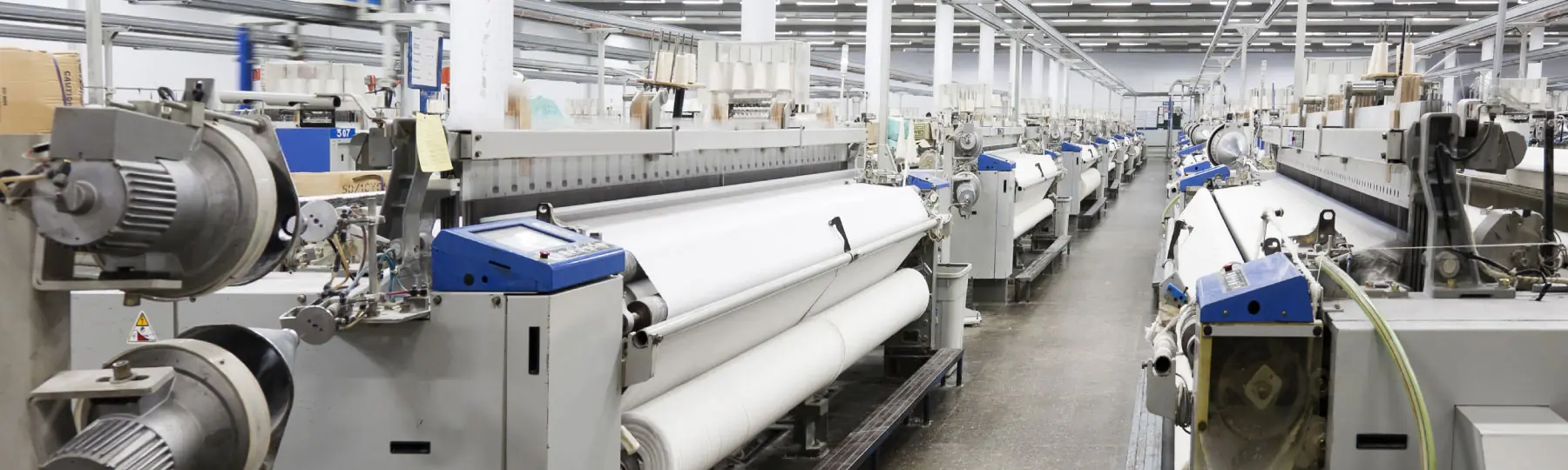
At a cotton weaving factory in Indonesia, the customer faced a significant challenge: productivity in the weaving process declined during the hot daytime hours.
Expanding the factory floor and installing numerous additional air-jet looms strained the capacity of the existing air conditioning system.
In the weaving process, especially when using cotton yarn, precise temperature and humidity control is essential for maintaining high product quality. To address this challenge, the factory resorted to air conditioning only half of the production floor.
However, in the non-air-conditioned areas, room temperatures rose as high as 35°C, frequently triggering thermal switches on the looms and causing machines to stop unexpectedly.
Each time a machine stopped, operators were required to inspect the quality of the work-in-progress, reset the weft yarn, and restart the operation, which placed a significant burden on them. Additionally, out of concern for further stoppages, the looms were operated at reduced speeds, inevitably leading to lower productivity.
The factory considered upgrading its air conditioning system, but the estimated cost of $300,000 made it difficult to justify the investment. As the thermal switches were set to activate at 32°C, it was essential to find a way to keep the room temperature below this threshold. Amid these challenges, the factory reached out to IKEUCHI for a solution, following a recommendation from a nearby spinning factory.
Solutions Proposed by IKEUCHI
Learn more about how humidity control can help solve common challenges in textile manufacturing:
Technical Papers on Dry Fog Humidification for Textile Manufacturing →
Related articles
-

Uniformly Moistening Deep inside the Yarn Cone
#Cost Reduction#Productivity Improvement#Quality Improvement#Textile
-
Humidity Control Solved Floor Wetting & Weaving Issues in Towel Production
#Insufficient Humidity#Productivity Improvement#Quality Improvement#Textile
-
Dry Fog Air Conditioning to Boost Output by 30% and Improve Quality in Textile Factories
#Boost yield#Equipment Downtime Prevention#Productivity Improvement#Quality Improvement#Textile
CONTACT US
For product inquiries or to request brochures, please click here.
